Gothic skull tattoos
A gothic skull tattoo comes from the old European habit of keeping death in plain sight: memento mori, vanitas painting, churchyard stone. It is only ever as good as the anatomy under the ornament.
90 designs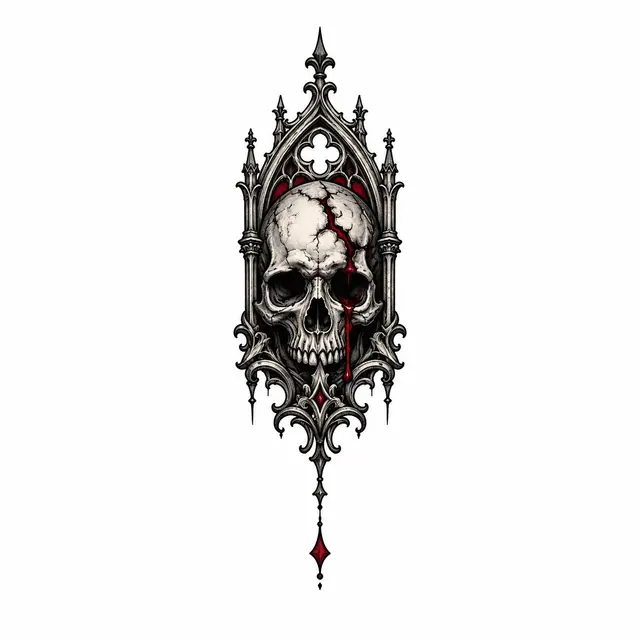
What makes a skull gothic
A bare skull is anatomy. A gothic skull comes with context: a guttering candle, a black rose, a rosary, a lace veil, a pointed arch behind it. Those extras tell people which tradition you are drawing on. It isn’t the pirate flag, the biker patch or the Mexican calavera, but the European habit of keeping death in view as a reminder to live well.
Before any ornament, though, the skull has to be drawn correctly. Three areas carry nearly all of its expression: the eye sockets, the nasal cavity and the line where the cheekbone meets the upper jaw. Get those right and a skull can carry a lot of decoration. Get them wrong and no filigree will save it. When you look through an artist’s portfolio, look for healed skulls, not just fresh ones.
Where the gothic skull comes from
Golgotha. The Gospels call the site of the crucifixion the place of the skull. Medieval painters often set a skull at the foot of the cross, following a legend that Adam was buried there. That is why skulls sit easily beside crosses and crowns of thorns, and why a skull carved on a church was never seen as blasphemy.
The Dance of Death. Fifteenth-century Danse Macabre paintings showed skeletons leading popes, kings, merchants and laborers off in one long procession. The message was that death treats everyone the same.
Memento mori and vanitas. The Latin phrase means “remember that you will die.” In the 17th century, Dutch painters built still lifes around the idea: a skull beside an hourglass, a candle burning down, a wilting flower, a closed book. Most of the skull ideas in our gallery come straight from that tabletop. Our memento mori page covers the hourglass and candle side in depth.
Graveyards and the stage. Shakespeare’s gravedigger scene, with Hamlet holding the skull of Yorick, fixed the image of a person in conversation with a skull. In colonial New England, winged death’s heads were carved on 17th and 18th-century headstones, and skull-decorated mourning rings were common in England in the same period.
Goth. When the goth subculture grew out of UK post-punk in the late 1970s and early 1980s, it took this whole vocabulary of skulls, crosses and mourning black and made it a look. Our history of gothic tattoos shows how these threads connect.
What a skull tattoo means today
There is no fixed code, so the reading depends on the person and the pairing. Common meanings today include:
- Live fully, time is short. The closest to the original memento mori.
- Mourning. A skull with a name, a date or a flower the person loved.
- Survival. Having faced illness, addiction or an accident and come through.
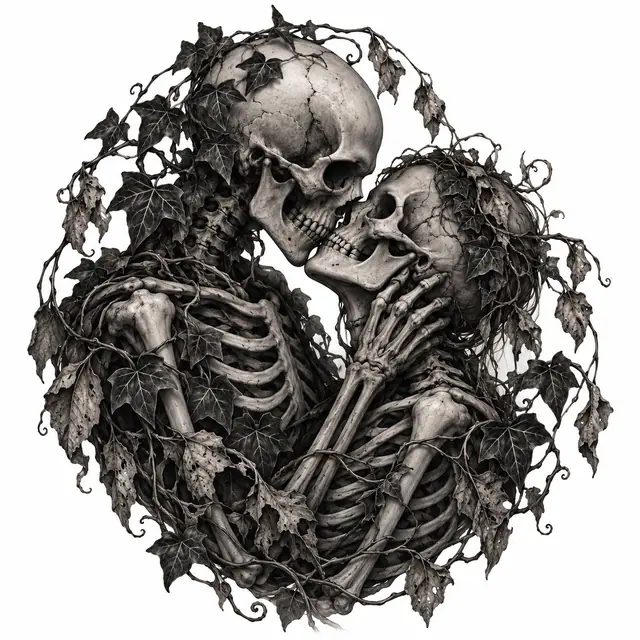
- Love beyond death. The idea behind two skulls kissing.
- Plain aesthetics. Plenty of people just love the shape, and that is enough.
Pairings shift the meaning. A crown of thorns or a rosary leans religious. A skull on an open book leans scholarly. A lace veil points to Victorian mourning, and for many wearers it softens the skull into something elegant.
Gothic skull tattoo ideas from the gallery
- Skull with a black rose growing from one eye socket. Life pushing through death. The rose needs to be big enough that its petals read clearly, so this is rarely smaller than 4 inches. See the black rose page for how to make petals look truly black.
- Skull veiled in Victorian lace. One of the most requested gothic skull tattoo ideas for women. Lace is a repeating pattern, and repeating patterns blur first, so give it room.
- Skull with moth wings spreading from the temples. A wide, symmetrical composition that suits the sternum or upper back.
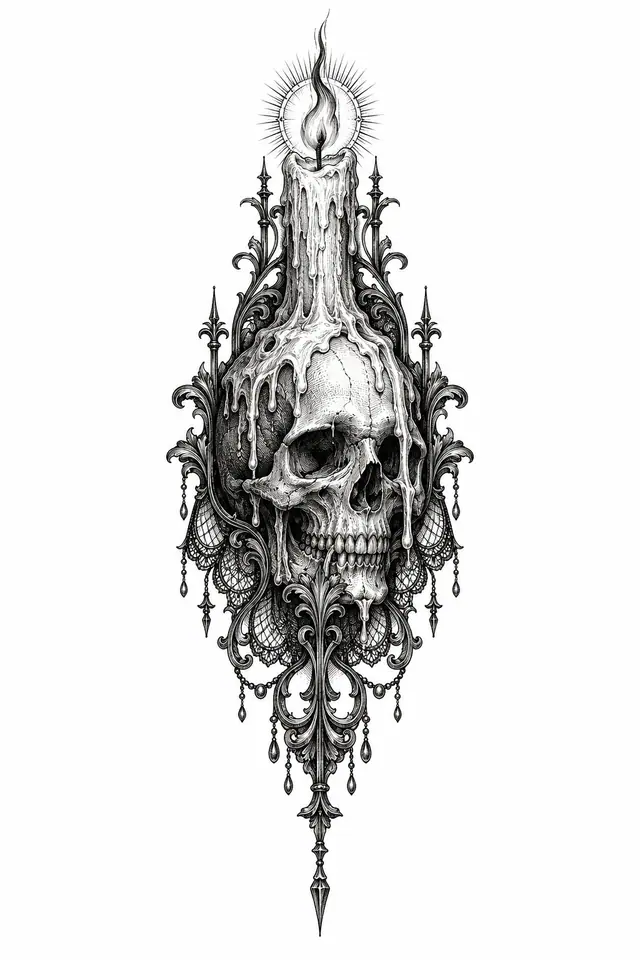
- Skull with a candle melting on top. Straight vanitas. A red flame is a strong single-accent idea.
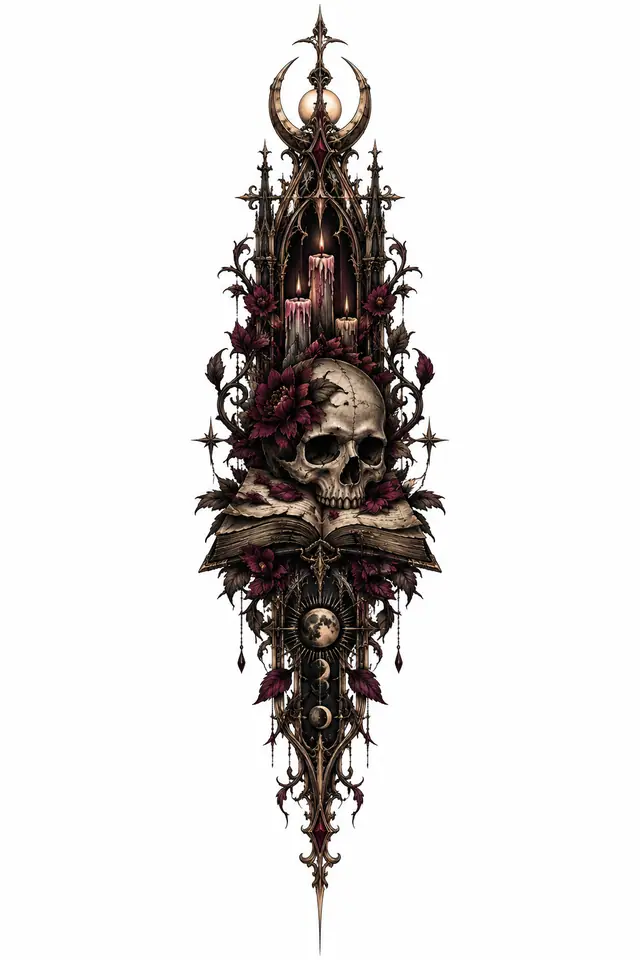
- Skull on an open antique book. Good for readers and writers. Keep any visible text to a few large letters or leave the pages blank.
- Skull wearing a crown of thorns, or wrapped in a rosary. The most openly religious versions.
- Side-profile skull with a filigree jaw. Tall and narrow, which makes it a natural forearm or calf piece.
- Two skulls kissing. A gothic lovers motif, often split between partners or kept as one piece.
- Skull held in a skeletal hand. The Hamlet pose, and a good fit for the back of the forearm.
- Skull carved like a cathedral gargoyle. Stone texture instead of bone.
- Cracked cranium. Simple, but the crack lines must be bold or they vanish.
Styles that suit a skull
Black and grey is the default for a reason. Soft grey wash shows the curve of the cranium, and deep black sockets give the face its weight. Browse our black and grey designs to see the range.
Blackwork is the best choice for small skulls. Solid sockets and a confident outline survive at sizes where shading would turn to mud.
Etching recalls the woodcut anatomy plates of Renaissance medical books, with crosshatched shading instead of smooth gradients. It looks antique and holds up well because it is made of lines, not soft washes. See our etching designs.
Red accent works when the red is one element only: the rose, the candle flame, a single drop. Spread red around and it stops being an accent.
Fine-line skulls look delicate but are the riskiest choice. Keep the sockets filled dark even in fine-line work, or the face loses its expression within a few years.
Dotwork gives bone a dry, chalky texture, and neo-traditional suits skulls framed with burgundy roses and antique gold.
Placement and size
| Design | Practical minimum | Good spots |
|---|---|---|
| Simple outline skull | about 1.5 in | wrist, ankle, behind the ear |
| Skull with one added element | 3 to 4 in | forearm, calf, shoulder |
| Lace-veiled or filigree skull | 5 in or more | outer forearm, upper arm, thigh |
| Full vanitas still life | 7 in or more | thigh, back, half sleeve |
A front-facing skull is symmetrical, so it belongs on a center line: sternum, throat, between the shoulder blades, back of the hand. Side-profile skulls follow long, narrow areas like the forearm and shin. Teeth are the detail that fails first at small sizes. Ask your artist to simplify them into a few bold shapes rather than drawing every tooth. Our placement guide covers how each body area ages.
A note on the Totenkopf
Totenkopf is simply German for death’s head, and the image had a long military history before the 20th century. The Nazi SS adopted a specific version, a front-facing skull with lower jaw over crossed bones in a flat badge style, and that design is now listed as a hate symbol. Ornamental gothic skulls are not confused with it. If you want a plain skull and crossbones, ask your artist to avoid the stiff military badge layout and you will have no issue.
Using the prompts
Every design in the gallery is an AI concept, and each one shows the ChatGPT prompt that made it. Open a skull you like, copy the prompt, then swap the rose for a moth or the style for etching. Take the result to a tattoo artist to redraw: AI images often get skull anatomy slightly wrong, with mismatched sockets or too many teeth, and a good artist will fix that while fitting the design to your body.
Skull tattoo designs
Questions people ask
What does a gothic skull tattoo mean?
The oldest reading is memento mori, a reminder that life is short and should be lived with intent. Today people also wear skulls for mourning, for having survived something serious, or for love that outlasts death. What you pair with the skull, such as a rose, a candle or a crown of thorns, usually decides which reading people see.
Is a skull tattoo evil or bad luck?
No. Skulls have appeared in Christian art for centuries, at the foot of the cross in crucifixion scenes, on church monuments and on gravestones. They were meant as sober reminders of mortality, not as signs of evil, and most people today read them as style or remembrance.
What is the difference between a sugar skull and a gothic skull?
A sugar skull, or calavera, comes from the Mexican Day of the Dead and is colorful and celebratory, decorated with flowers and patterns. A gothic skull comes from European memento mori and vanitas art, and is usually black and grey with ornament such as lace, roses, candles or filigree.
How big should a skull tattoo be?
A simple outline skull can work at about 1.5 inches if the eye sockets stay open and dark. A skull with one added element, like a rose or candle, needs 3 to 4 inches. Lace veils, filigree jaws and full still lifes need 5 inches or more to stay readable as the ink settles.
Can a skull tattoo be mistaken for a hate symbol?
Only one specific design causes real problems: the Nazi SS Totenkopf, a front-facing skull over crossed bones in a stiff badge style. Ornate gothic skulls with roses, lace or candles are not confused with it, but if you want a plain skull and crossbones, ask your artist to avoid the military badge layout.
Related motifs
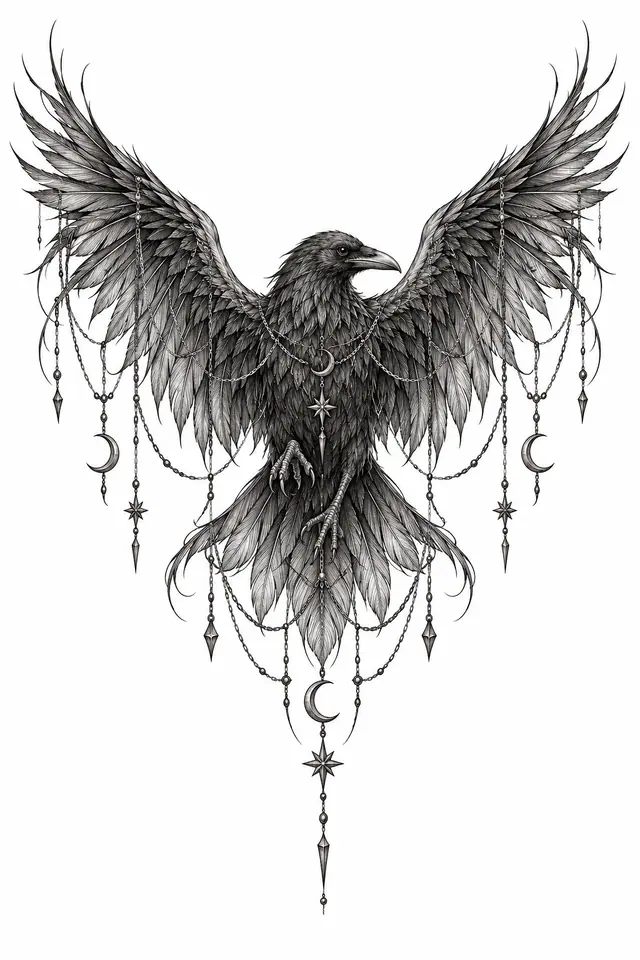 Raven and crowPoe's messenger, read as omen, memory and intelligence.
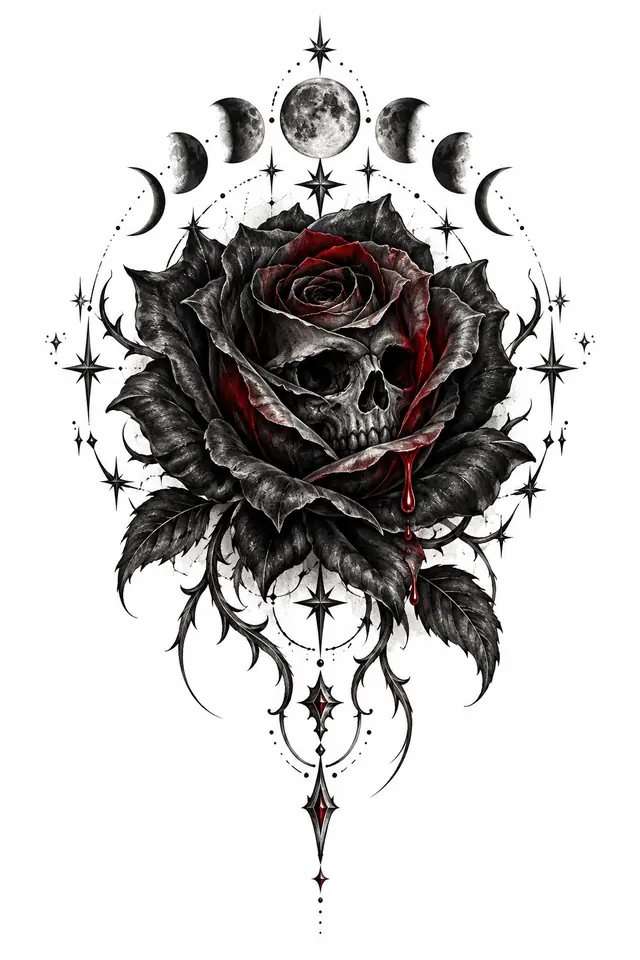 Black roseLove that outlives loss, grief and farewells.
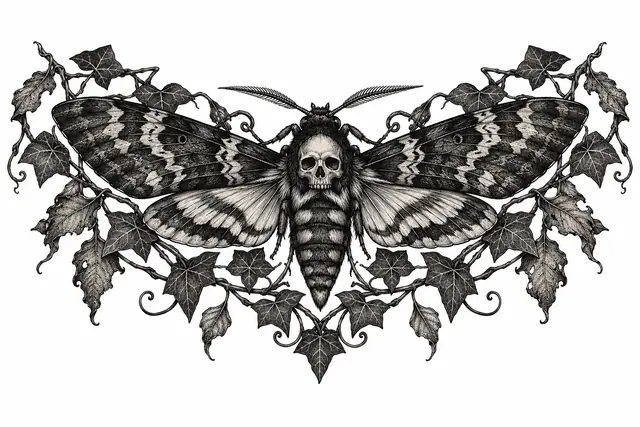 MothDrawn to the flame: transformation, night and the soul.
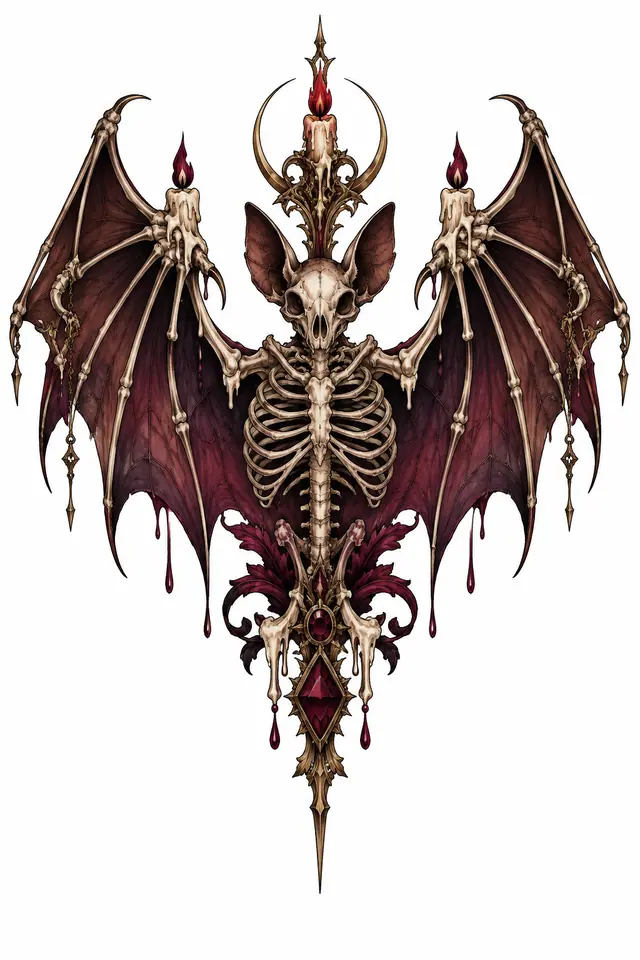 BatCreature of the night, linked with rebirth and Dracula.
 Gothic crossFaith in stone and thorns, from churchyards to chains.
 CathedralPointed arches and rose windows from 12th-century France.
 GargoyleStone guardians that kept rain and evil off the roof.
 VampireRomance and hunger, from Victorian novels to now.
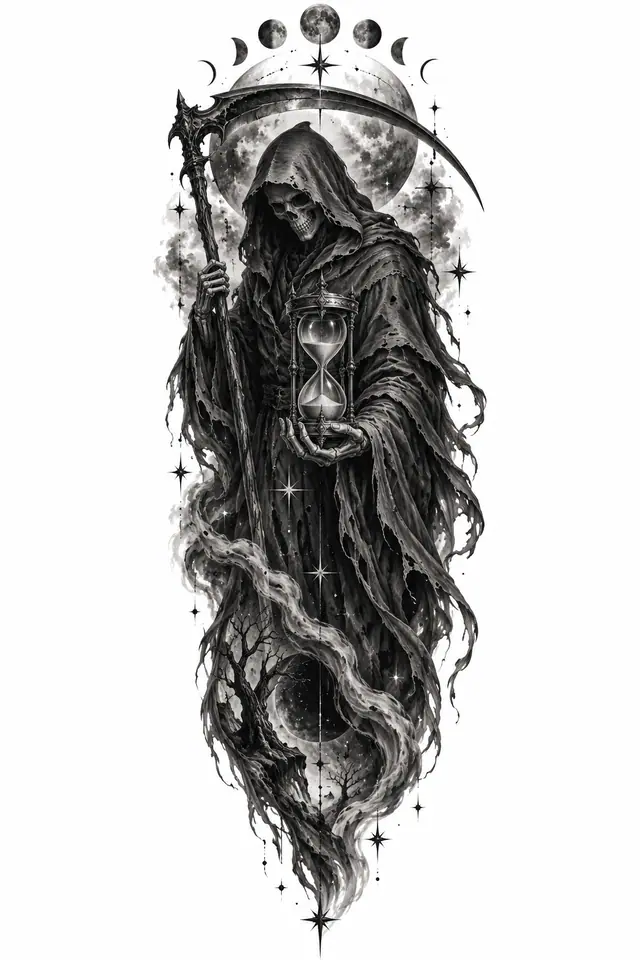 Grim reaperDeath personified, a reminder rather than a threat.