Memento mori tattoos
Memento mori is Latin for 'remember that you will die.' As a tattoo it usually takes the form of a skull, an hourglass, a burning candle or a stopped clock, objects borrowed from centuries of European art about time running out.
60 designs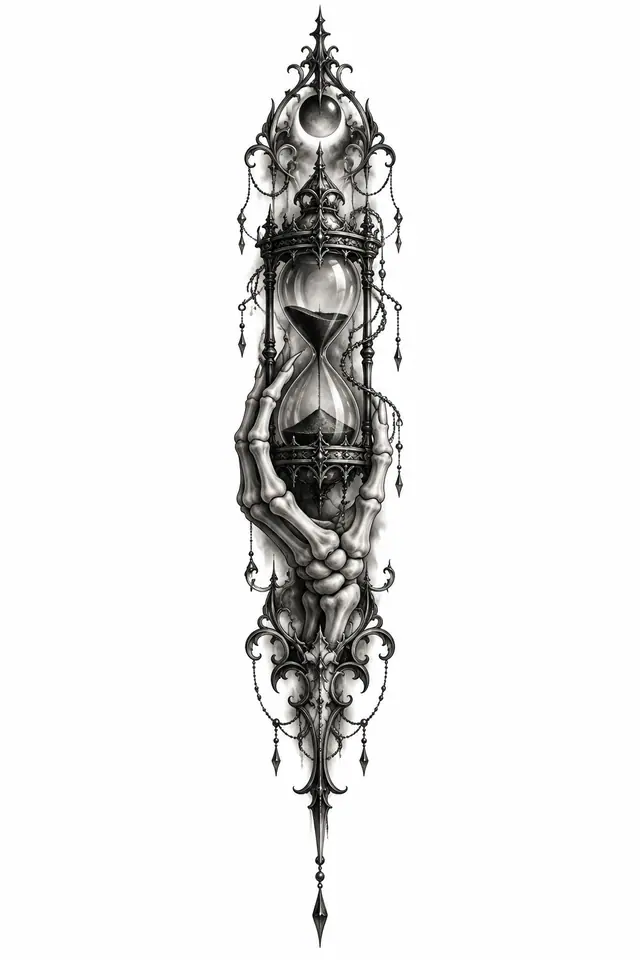
What memento mori means
Memento mori is a Latin phrase meaning “remember that you will die.” It isn’t one picture but a family of objects that artists have used for centuries to say the same thing: the skull, the hourglass, the candle burning down, the clock, the wilting flower.
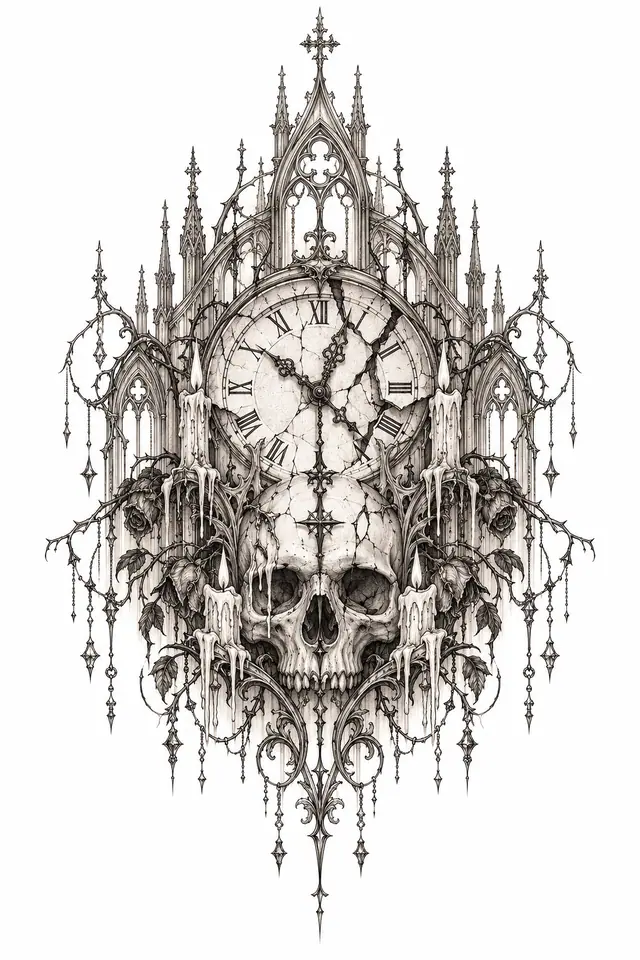
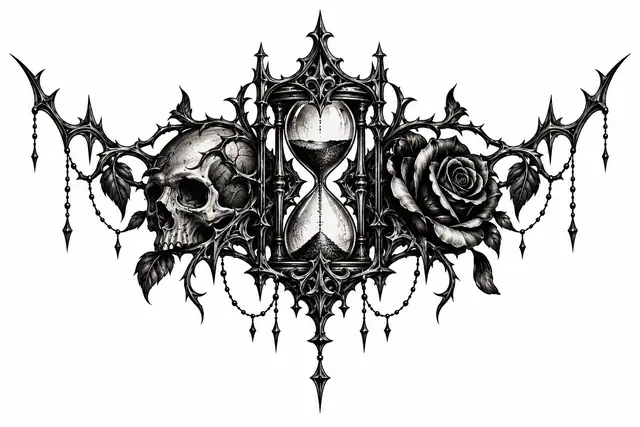
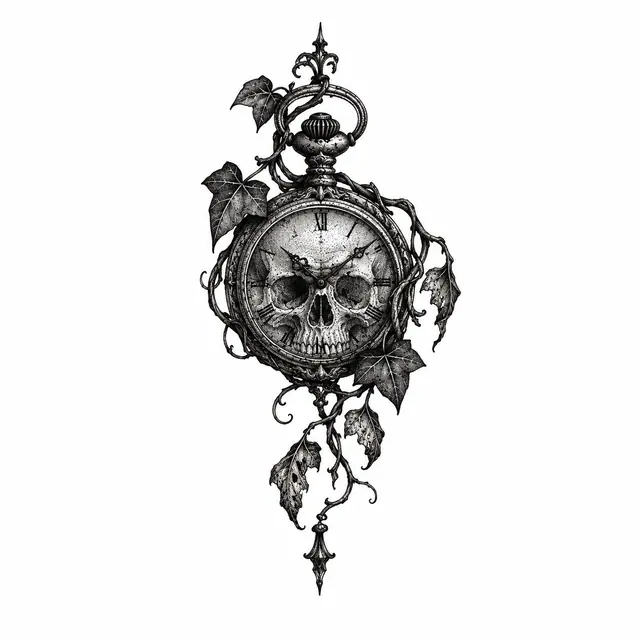
That makes it one of the most flexible motifs in gothic tattooing. You can get the full still life or pick a single object that carries the whole idea. Our gallery includes a classic still life of skull, hourglass and burning candle; an hourglass pouring sand between a skull and a rose; an antique pocket watch with a skull face; a candle burned to its last inch with wax dripping; a winged hourglass; a skeleton hand holding an hourglass; a Victorian still life with a skull and wilting flowers; and a broken clock with Roman numerals and a skull.
Where it comes from
The idea is ancient. Stoic writers such as Seneca and Marcus Aurelius returned again and again to the practice of keeping death in mind so as to live better. You’ll also often hear that a servant rode behind victorious Roman generals reminding them they were mortal. That story comes from later writers, and the exact words are uncertain, so treat it as tradition.
The two-word phrase became a fixed motto in Christian Europe, where reminders of death were part of devotion. By the 16th and 17th centuries it showed up on rings, brooches and tomb monuments. Watchmakers of the period even made small watches in the shape of skulls, which makes the pocket watch with a skull face in our gallery older in spirit than it looks.
The richest source of memento mori imagery is the vanitas still life, painted in large numbers in the 17th century Dutch Republic, with Leiden and Haarlem as two of its centers. Painters such as Harmen Steenwijck in Leiden and Pieter Claesz in Haarlem arranged skulls, hourglasses, guttering candles, books, watches and flowers on a table. The name comes from the opening of Ecclesiastes in the Latin Bible, “vanitas vanitatum,” vanity of vanities. Every object in these paintings was chosen to say that wealth, learning and beauty all end.
The same symbols moved onto gravestones. In 17th and 18th century New England, carvers decorated slate headstones with winged skulls and winged hourglasses, a direct picture of the Latin saying “tempus fugit,” time flies.
What each object says
| Object | Traditional reading |
|---|---|
| Skull | Death itself, the end everyone shares |
| Hourglass | A life with a measured length, time running out |
| Winged hourglass | Time flies |
| Burning candle | A life consuming itself |
| Snuffed or guttering candle | Death, a life just ended |
| Wilting flowers | Youth and beauty fading |
| Pocket watch or clock | The passing hours; a stopped clock marks a moment |
The amount of sand left in the upper bulb is sometimes read as the time the wearer has left. That reading is modern, and it’s worth deciding on purpose: an hourglass with the top nearly empty sends a heavier message than one just turned over.
What it means today
Today memento mori is often read less as a warning and more as a motivator. Its modern revival owes a lot to renewed interest in Stoic philosophy, where remembering death is a way to stop wasting time. People also choose it after a loss, after a health scare, or as a quiet counterweight to a busy life.
Clocks have picked up a personal use the vanitas painters never intended. Many people set the hands to a meaningful time: the hour a child was born, or the time a parent died. If you do this, write the time down for your artist and check it on the stencil, because a clock face reads as a clock long before anyone can read the exact hour.
Popular designs and combinations
The full still life is the most faithful to the paintings. It needs a clear hierarchy: one object as the hero, usually the skull, with the hourglass and candle behind or beside it. Three equal objects in a row look like a shelf, not a composition.
The hourglass alone is naturally vertical, which suits an inner forearm, the spine or the back of the calf. Add wings and it widens into a good chest or upper back piece.
The candle is the simplest memento mori. A single taper with long wax drips is elegant at small sizes, and a moth circling the flame adds the old image of the soul drawn to light.
Skull plus rose: a black rose beside the hourglass brings in the vanitas theme of fading beauty without a full flower arrangement.
The skeleton hand with an hourglass overlaps with grim reaper imagery and can be read as death presenting your time to you.
Lettering: the words “memento mori” or “tempus fugit” in blackletter suit this motif well, since the phrases come from the same centuries as the script. You can try layouts in our Gothic lettering generator.
Styles that suit it
Etching is the closest match to the period. Engraved prints of vanitas subjects circulated widely, and fine crosshatching gives skulls and drapery the look of a 17th-century plate. See our etching designs for the effect.
Black and grey realism recreates the painterly side of vanitas: polished skull bone, translucent wax, the glow around a flame.
Fine-line suits single objects, a candle or a small hourglass, but not a crowded still life.
Red accent is easy to place here: the candle flame, or a red rose petal falling through the hourglass.
Dotwork handles sand beautifully. Individual grains can’t be tattooed, but a stippled mass in each bulb and a dotted stream between them reads as sand at any distance.
Placement and size
- Hourglass: at least 2.5 to 3 inches tall, so both bulbs, the frame posts and the sand stream stay separate.
- Clock or pocket watch with Roman numerals: about 2.5 to 3 inches across. Smaller than that, replace the numerals with tick marks or they will blur into a ring.
- Candle: works from about 2 inches, which makes it one of the few memento mori symbols that suits a wrist or ankle.
- Full still life with three or more objects: 5 to 7 inches minimum. Inner forearm designs, calf and outer thigh are the usual homes.
- Lettering: keep lowercase letters at least about 1 cm (0.4 in) tall, since blackletter has tight counters that fill in.
Using the prompts
All the designs here are AI concepts, so an artist should redraw your chosen one for the body before it is tattooed. Open any design to copy its ChatGPT prompt, then swap the skull for a raven or change the candle for a pocket watch to build your own version.
Memento mori tattoo designs
Questions people ask
What does a memento mori tattoo mean?
It means 'remember that you will die,' a reminder that life is short. Most people wear it as motivation rather than gloom: a nudge to spend their time on what matters, since none of it is guaranteed.
What does an hourglass tattoo mean?
An hourglass stands for time passing and for a life that has a measured length. In memento mori art it shows that the sand is always running. A winged hourglass adds the idea that time flies.
What does a candle mean in a gothic tattoo?
A burning candle is a life consuming itself, and a guttering or snuffed candle stands for death. Dutch vanitas painters used candles this way in the 17th century, and the meaning carries straight over into gothic tattoos.
Is memento mori a religious tattoo?
It can be, but it doesn't have to be. The idea appears in ancient Stoic philosophy and in Christian devotion, and today it is just as often worn by people with no religion who like its practical message.
How do you spell memento mori?
It is memento mori, with an e in memento. 'Momento mori' is a common misspelling, so check the stencil carefully before any lettering goes on.
Related motifs
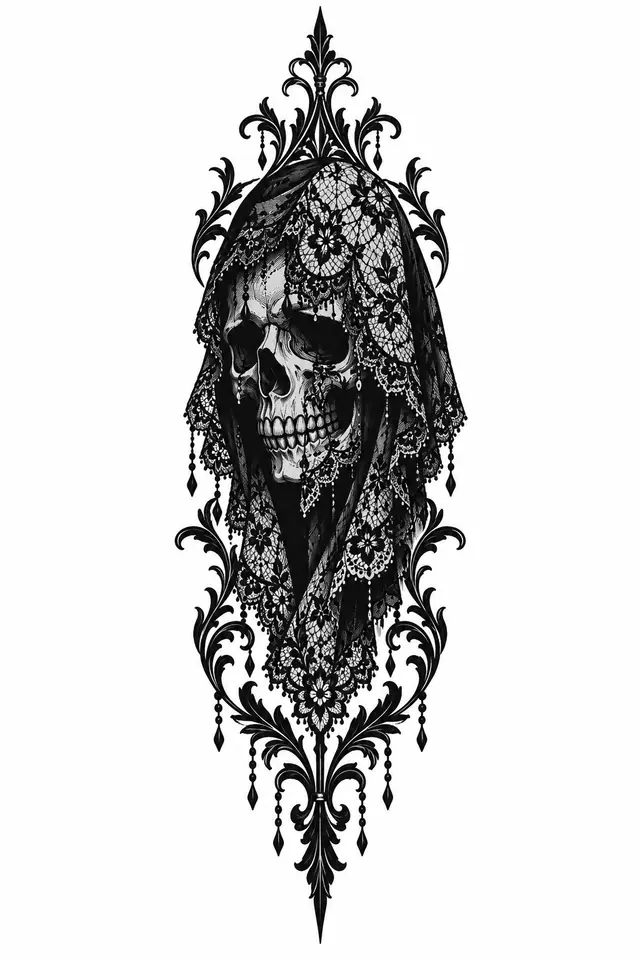 SkullMortality worn openly: the oldest reminder that life is short.
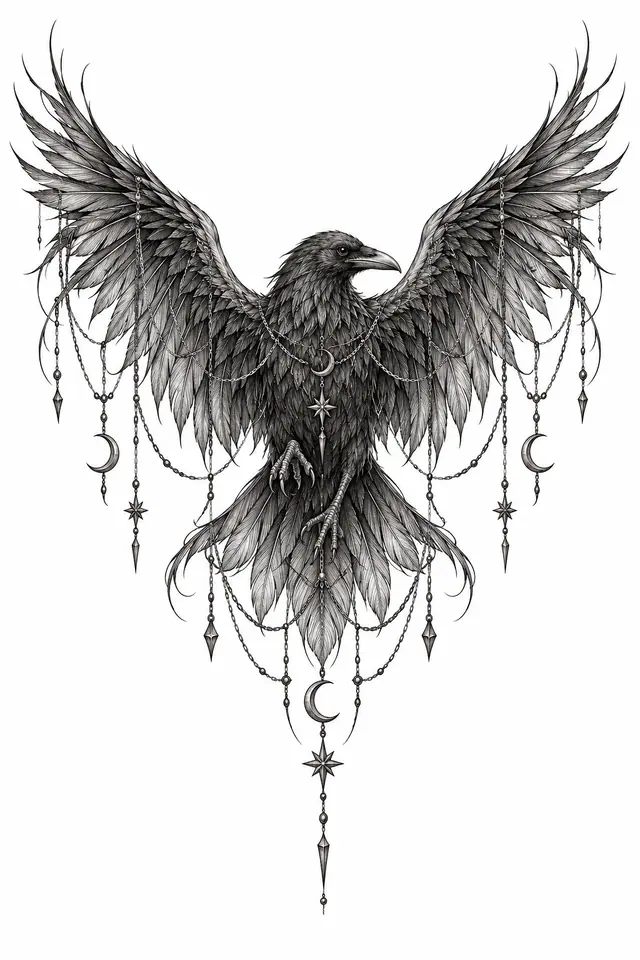 Raven and crowPoe's messenger, read as omen, memory and intelligence.
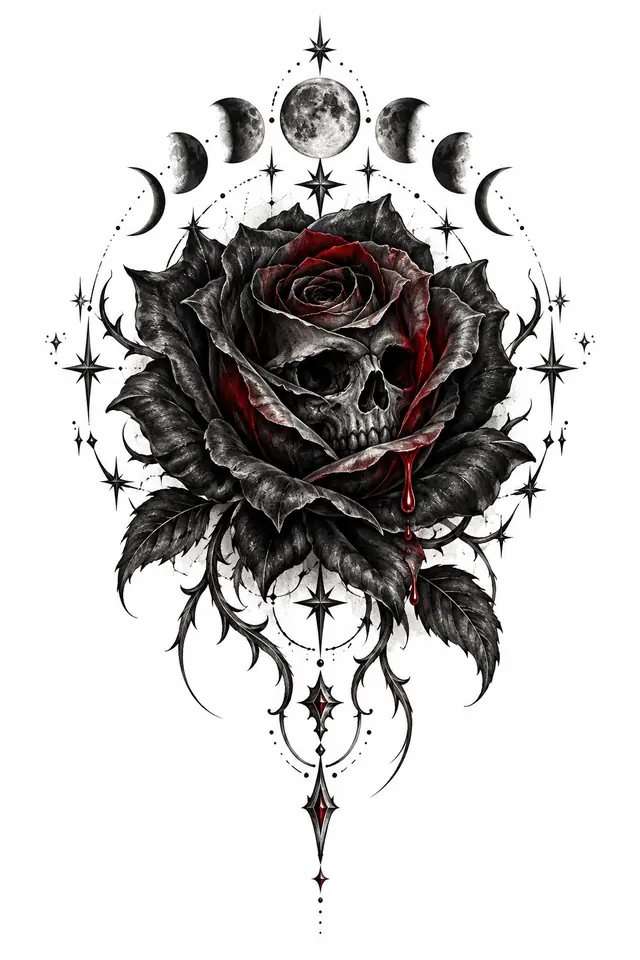 Black roseLove that outlives loss, grief and farewells.
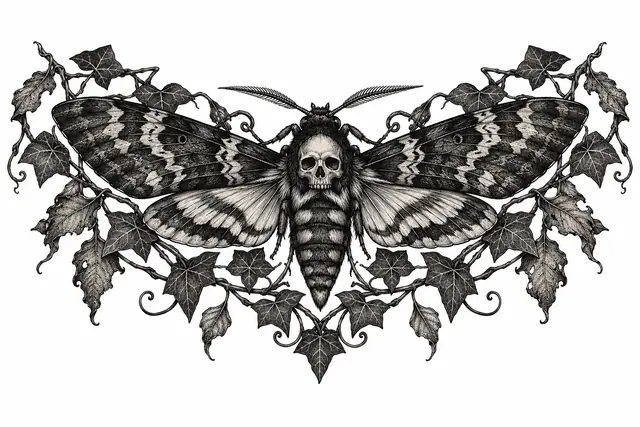 MothDrawn to the flame: transformation, night and the soul.
 BatCreature of the night, linked with rebirth and Dracula.
 Gothic crossFaith in stone and thorns, from churchyards to chains.
 CathedralPointed arches and rose windows from 12th-century France.
 GargoyleStone guardians that kept rain and evil off the roof.
 VampireRomance and hunger, from Victorian novels to now.